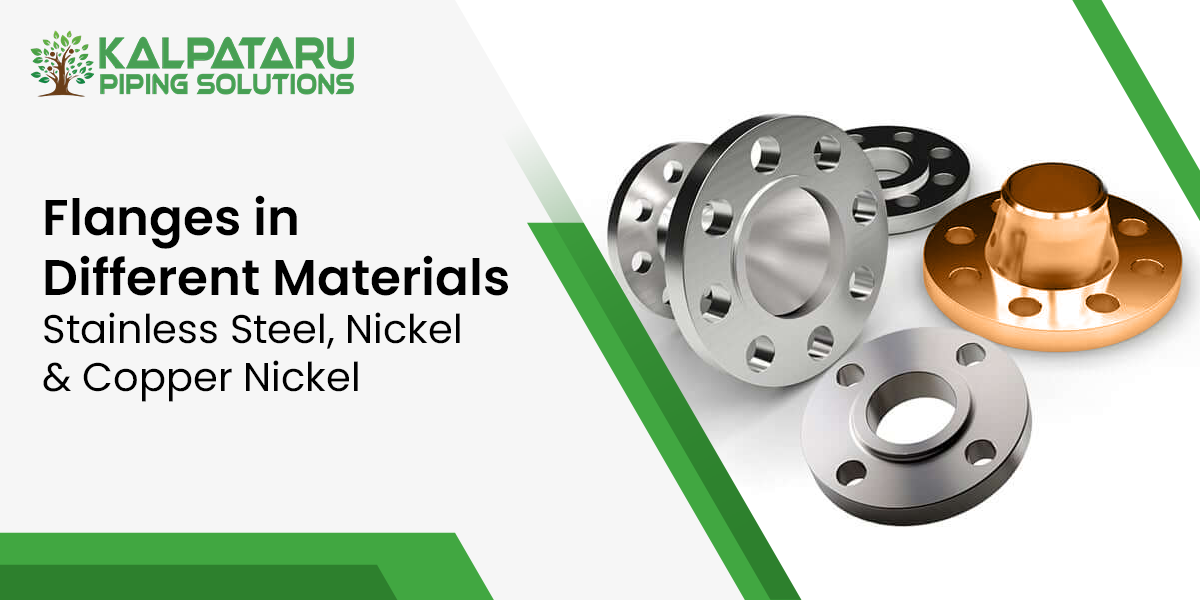
Choosing the right flange material is as important as choosing the right flange type. The same weld neck or slip-on design behaves very differently in seawater, acid service, or high-temperature steam depending on whether it is made from stainless steel, a nickel alloy, or copper nickel. This guide explains what flanges do, the common types, and how the three major material families compare — so you can specify the right flange for your piping system.
What Are Flanges?
Flanges are the connection points of a piping system — they join pipes, valves, pumps, and equipment into one assembly, typically by welding or threading onto the component and bolting to a mating flange with a gasket in between. Their biggest advantage is serviceability: instead of cutting and re-welding pipe, a flanged joint can be unbolted for inspection, cleaning, or replacement of just the problem section.
Explore our complete range of industrial steel flanges covering all major types and materials.
Common Types of Flanges Used in Piping Systems
- Weld Neck Flange – tapered hub butt-welded to the pipe; the strongest joint for high pressure and temperature.
- Slip-On Flange – slides over the pipe and is fillet-welded; economical and easy to align for low-pressure lines.
- Socket Weld Flange – pipe inserts into a socket bore; ideal for small-bore, high-pressure piping.
- Blind Flange – solid disc used to close off a line or vessel opening for future access.
- Threaded Flange – screws onto the pipe without welding; suited to low-pressure, non-cyclic service.
- Lap Joint Flange – used with a stub end; rotates freely for easy bolt alignment, common with costly alloys.
Stainless Steel Flanges
Stainless steel flanges are the industry workhorse thanks to their corrosion resistance, strength, and cost balance. They serve in utility and scrubber assemblies, acid manufacturing, fertiliser plants, heat exchangers, and boiler systems.
Popular grades include SS 304/304L flanges for general service, SS 316/316L/316Ti flanges where chloride resistance matters, and SS 904L flanges for aggressive acid environments. For higher strength with excellent pitting resistance, consider duplex steel flanges and super duplex steel flanges.
Nickel & Nickel Alloy Flanges
Nickel flanges excel where stainless steel reaches its limits: seawater, saline and brine solutions, organic chemicals, caustic media, and diluted non-oxidizing acids. Pure nickel Nickel 200/201 flanges handle caustic soda service, while alloyed grades extend performance further:
- Monel 400 / K500 flanges – outstanding in seawater and hydrofluoric acid
- Inconel 625 flanges – high strength plus resistance to pitting and crevice corrosion
- Inconel 600/601 flanges – oxidation resistance at elevated temperatures
- Incoloy 825 flanges – built for sulphuric and phosphoric acid service
- Incoloy 800 flanges – creep and oxidation resistance in high-heat plant
Copper Nickel Flanges
Copper nickel flanges are the first choice for marine and seawater cooling systems. The alloy naturally resists biofouling and seawater corrosion, and Cu-Ni slip-on flanges are easy to weld and install, making them ideal for low-pressure shipboard and offshore lines.
Two standard grades are available: Copper Nickel 90/10 flanges for general marine service, and Copper Nickel 70/30 flanges where higher strength and erosion resistance are needed.
Which Flange Material Should You Choose?
| Material | Best For | Typical Industries |
| Stainless Steel | General corrosion resistance, hygiene, cost-effectiveness | Chemical, fertiliser, food, boilers, heat exchangers |
| Nickel Alloys | Severe corrosion, high temperature, acids and caustics | Oil & gas, petrochemical, chemical processing, power |
| Copper Nickel | Seawater, brine, biofouling resistance, low pressure | Marine, shipbuilding, offshore, desalination |
Buy Flanges from a Trusted Manufacturer & Exporter
Kalpataru Piping Solution is a leading manufacturer, trader, and exporter of flanges in stainless steel, high nickel alloys, copper nickel, and carbon steel — alongside pipe fittings, tube fittings, round bars, and steel tubes. Every flange is supplied with dimensional precision, high-end finishing, and mill test certification. Share your size, grade, and pressure class — our team will quote the right flange for your application.
Get a Quote: +91 22-66337137 | info@kalpatarupipingsolution.com | www.kalpatarupipingsolution.com
Frequently Asked Questions
Enquire Now
Related Blogs
What is Stainless Steel Valve?
What Is Monel Alloy? Composition, Properties & Uses (Guide)