
A gate valve is the workhorse of industrial pipeline isolation. When you need to fully open or fully close a line with minimal flow restriction and a proven sealing mechanism, nothing delivers it more reliably than a well-engineered gate valve. The sliding wedge (or gate) drops perpendicular to the flow path, creating a robust metal-to-metal or soft-seal shutoff that has been trusted in oil and gas, power plants, water treatment, and chemical processing for over a century.
What distinguishes one gate valve from another isn’t the principle, it’s the engineering details: the wedge geometry, bonnet design, stem type, packing, and material that together determine whether the valve survives 5 years or 30 years in service. A gate valve installed in a 20,000 psi hydrogen line demands a pressure seal bonnet. A sluice gate in a water treatment plant needs a corrosion-resistant coating and rising stem for position indication. A cryogenic gate valve requires extended bonnets and low-temperature alloy seats.
Kalpataru Piping Solution manufactures and exports the full range of gate valves — cast, forged, knife-edge, and sluice designs in carbon steel, stainless steel, alloy steel, and exotic alloys, backed by API 600/BS 1414 compliance, EN 10204 Type 3.1 MTCs, and export to 30+ countries.
- What are Duplex Steel Valves?
- Gate Valves Material Grade
- Gate Valve Technical Specifications
- Gate Valve Pressure-Temperature (P-T) Ratings — ASTM A216 WCB / ASME B16.34
- Gate Valve Pressure-Temperature (P-T) Ratings — ASTM A216 WCB / ASME B16.34
- Types of Gate Valves
- Gate Valve Materials of Construction
- End Connections, Actuation & Gate Valve Parts
- Advantages of Gate Valves
- Gate Valve Applications by Industry
- Frequently Asked Questions — Gate Valves
Technical Data
Gate Valve vs Ball Valve vs Globe Valve
| Feature | Gate Valve | Ball Valve | Globe Valve |
| Primary Function | Full isolation (on/off) | Full isolation (on/off) | Throttling & regulation |
| Flow Restriction | Very low (full bore) | Very low (full bore) | High (tortuous path) |
| Pressure Drop | Negligible when open | Negligible when open | Moderate to high |
| Operation Speed | Slow (multi-turn) | Fast (quarter-turn) | Slow (multi-turn) |
| Throttling Suitability | Not suitable | Not suitable | Excellent |
| Pipe Sizes | 1/2″ to 36″+ | 1/4″ to 48″ | 1/2″ to 24″ |
| Pressure Class Range | 150# to 2500# | 150# to 2500# | 150# to 1500# |
| Space Required | Tall (rising stem) | Compact | Moderate |
| Best For | Pipeline mainline isolation | Process isolation, frequent cycling | Flow control, bypass |
| Maintenance Difficulty | Moderate | Low | Moderate |
Gate Valve Technical Specifications
| Parameter | Specification |
| Design Standard | API 600 (Cast Steel), API 602 (Forged Steel), BS 1414, DIN 3352, ASME B16.34 |
| Face-to-Face | ASME B16.10 |
| Flanged Ends | ASME B16.5 (NPS 1/2″-24″) / ASME B16.47 (NPS 26″+) |
| Butt Weld Ends | ASME B16.25 |
| Socket Weld / Screwed | ASME B16.11 |
| Pressure Class | 150#, 300#, 600#, 800#, 900#, 1500#, 2500# |
| Size Range | 1/2″ to 36″ (cast); 1/4″ to 2-1/2″ (forged) |
| Working Pressure | Up to 6,000 PSIG (Class 2500, ambient) |
| Temperature Range | -196°C to +650°C (grade-dependent) |
| Bonnet Type | Bolted Bonnet (standard), Pressure Seal Bonnet (900# & above) |
| Stem Type | Rising Stem OS&Y, Non-Rising Stem (NRS), Inside Screw |
| Wedge Type | Solid Wedge, Flexible Wedge, Split Wedge, Parallel Slide Gate |
| Seating | Metal-to-Metal (Stellite hard-faced), Soft Seat (EPDM), Resilient-Seated |
| Body-Bonnet Joint | Bolted (RF gasket / spiral wound), Pressure Seal (spring-energized) |
| Gland Packing | Graphite / PTFE / Braided Asbestos-Free |
| Bypass Arrangement | Available (optional, for large high-pressure valves) |
| Drain Plug | Available (optional) |
| Testing | API 598 / BS EN 12266-1 |
| Shell Test | 1.5× WP hydrostatic (no leakage) |
| Seat Test | 1.1× WP hydrostatic + low-pressure air |
| MTC | EN 10204 Type 3.1 (standard) / Type 3.2 (on request) |
Gate Valve Pressure-Temperature (P-T) Ratings — ASTM A216 WCB / ASME B16.34
| Temperature | Class 150 | Class 300 | Class 600 | Class 900 | Class 1500 | Class 2500 |
| -29°C to 38°C (-20 to 100°F) | 285 PSI | 740 PSI | 1,480 PSI | 2,220 PSI | 3,705 PSI | 6,170 PSI |
| 100°C (212°F) | 260 PSI | 680 PSI | 1,360 PSI | 2,035 PSI | 3,395 PSI | 5,655 PSI |
| 150°C (300°F) | 230 PSI | 600 PSI | 1,200 PSI | 1,795 PSI | 2,995 PSI | 4,990 PSI |
| 200°C (400°F) | 200 PSI | 520 PSI | 1,040 PSI | 1,560 PSI | 2,600 PSI | 4,330 PSI |
| 260°C (500°F) | 170 PSI | 440 PSI | 875 PSI | 1,315 PSI | 2,190 PSI | 3,655 PSI |
| 315°C (600°F) | 140 PSI | 365 PSI | 730 PSI | 1,095 PSI | 1,825 PSI | 3,040 PSI |
| 370°C (700°F) | 125 PSI | 325 PSI | 655 PSI | 985 PSI | 1,640 PSI | 2,730 PSI |
| 425°C (800°F) | 110 PSI | 290 PSI | 580 PSI | 870 PSI | 1,450 PSI | 2,415 PSI |
| 480°C (900°F) | 95 PSI | 250 PSI | 500 PSI | 750 PSI | 1,250 PSI | 2,085 PSI |
WCB carbon steel per ASME B16.34. P-T ratings vary by material group; verify against individual valve design for critical service. SS grades (CF8M) have different derating curves.
Gate Valve Materials of Construction
Cast Gate Valve Body Materials
| ASTM Grade | Material | Temp Range | Typical Service |
| A216 Gr. WCB | Carbon Steel | -29°C to 425°C | General service, steam, oil, gas |
| A217 Gr. WC1 | 1/2Mo Steel | -29°C to 540°C | High-temp steam |
| A217 Gr. WC6 | 1-1/4Cr-1/2Mo | -29°C to 593°C | High-temp, HP steam |
| A217 Gr. WC9 | 2-1/4Cr-1Mo | -29°C to 650°C | Boiler feed, HP steam |
| A217 Gr. C5 | 5Cr-1/2Mo | -29°C to 650°C | Refinery high-temp H2S |
| A217 Gr. C12 | 9Cr-1Mo | -29°C to 650°C | High-temp oxidizing |
| A351 Gr. CF8 | SS 304 (cast) | -196°C to 540°C | Cryogenic, general corrosion |
| A351 Gr. CF3 | SS 304L (cast) | -196°C to 425°C | Low-carbon austenitic |
| A351 Gr. CF8M | SS 316 (cast) | -196°C to 540°C | Chlorides, acids, marine |
| A351 Gr. CF3M | SS 316L (cast) | -196°C to 425°C | Low-carbon, weldable |
| A351 Gr. CF8C | SS 347 (cast) | -196°C to 815°C | High-temp sensitization resistance |
| A351 Gr. CN7M | Alloy 20 (cast) | -73°C to 315°C | Sulfuric acid, chemical |
| A351 Gr. CK3MCuN | SS 254 SMO (cast) | -73°C to 400°C | High chloride, seawater |
| A351 Gr. CD4MCu | Duplex 2205 (cast) | -46°C to 315°C | Seawater, chloride SCC |
| A352 Gr. LCB | Low-Temp C Steel | -46°C to 345°C | Cryogenic (moderate) |
| A352 Gr. LCC | Low-Temp C Steel | -73°C to 345°C | Cryogenic service |
| A494 Gr. CW6MC | Inconel 625 (cast) | -196°C to 1000°C | Acid, high-temp corrosion |
| A494 Gr. CW2M | Hastelloy C-276 (cast) | -73°C to 650°C | Aggressive acids, HCl |
| A494 Gr. CY40 | Inconel 600 (cast) | -196°C to 870°C | High-temp oxidizing |
| A995 Gr. 1A | Duplex (2205 cast) | -46°C to 315°C | Offshore, seawater |
| A995 Gr. 4A | Super Duplex (2507 cast) | -46°C to 300°C | High chloride, aggressive media |
| A995 Gr. 5A | Zeron 100 (cast) | -46°C to 300°C | Seawater, subsea |
| A995 Gr. 6A | Super Duplex SAF 2507 | -46°C to 300°C | Offshore, chemical |
Size and Pressure Class Availability Matrix
| Gate Valve Type | Class 150 | Class 300 | Class 600 | Class 800 | Class 900 | Class 1500 | Class 2500 |
| Bolted Bonnet (Cast) | 1/2″-80″ | 2″-48″ | 2″-42″ | — | — | — | — |
| Forged (API 602) | — | 1/2″-2″ | 1/2″-2″ | 1/2″-2″ | — | 1/2″-2″ | 1/2″-2″ |
| Pressure Seal (Cast) | — | — | — | — | 1/2″-24″ | 1/2″-24″ | 1/2″-12″ |
| Cryogenic (Cast) | 2″-36″ | 2″-36″ | 2″-24″ | — | — | — | — |
| Knife Edge Gate | 2″-24″ | 2″-24″ | — | — | — | — | — |
| Sluice Gate Valve | 2″-48″ | — | — | — | — | — | — |
End Connections, Actuation & Gate Valve Parts
End Connection Options
| Connection Type | Code | Standard | Typical Size Range |
| Raised Face Flange | RF | ASME B16.5 / B16.47 | 1/2″ to 60″ |
| Flat Face Flange | FF | ASME B16.5 | 1/2″ to 24″ |
| Ring Type Joint | RTJ | ASME B16.20 | 1/2″ to 24″ |
| Tongue & Groove | T&G | ASME B16.5 | 1/2″ to 24″ |
| Butt Weld | BW | ASME B16.25 | 1/2″ to 36″ |
| Socket Weld | SW | ASME B16.11 | 1/4″ to 2″ |
| Screwed NPT | NPT | ASME B1.20.1 | 1/4″ to 2″ |
| Screwed BSP | BSP | BS EN 10226 | 1/4″ to 2″ |
Actuation Options
| Actuation Type | Code | Suitable For | Remarks |
| Handwheel | HW | All sizes, manual service | Most common, direct mount |
| Gear Operator | GO | Sizes above 6″, or high-pressure | Reduces operating torque |
| Pneumatic (Double Acting) | DA | Remote operation, process control | Air-to-open, air-to-close |
| Pneumatic (Spring Return) | SR | ESD / fail-safe | Fail-open or fail-closed |
| Electric Motor Actuator | EMA | Remote, automated plant | 24V, 110V, 415V options |
| Hydraulic Actuator | HYD | Subsea, high-torque, offshore | Used on large pressure seal valves |
Gate Valve Principal Parts
| Part | Material (Standard) | Function |
| Body | As specified (WCB, CF8M, etc.) | Pressure-containing shell |
| Bonnet | Same as body | Houses stem, packing, covers wedge pocket |
| Wedge / Gate | Body material or upgraded trim | Moving closure element |
| Stem | AISI 410, SS 316, Alloy 6 | Transmits force to raise/lower wedge |
| Backseat | Integral / Renewable | Secondary stem seal when packing replaced |
| Yoke | Carbon/Alloy/SS | Supports yoke nut and stem |
| Yoke Nut (Yoke Sleeve) | Bronze, SS | Converts stem rotation to linear motion |
| Packing | Graphite / PTFE / PTFE-Graphite | Primary stem seal, fugitive emission control |
| Body-Bonnet Gasket | Spiral Wound (SS+Graphite), RTJ | Body-bonnet seal |
| Handwheel | Cast Iron / Ductile Iron | Manual operation |
| Seat Rings | Stellite Hard-Faced / Renewable | Seating surfaces |
| Gland Follower | SS / Carbon Steel | Compresses packing |
| Bypass Valve | Integral (optional) | Pressure equalization before opening |
Gate Valves Material Grade
Types of Gate Valves
1. Bolted Bonnet Gate Valve (OS&Y)
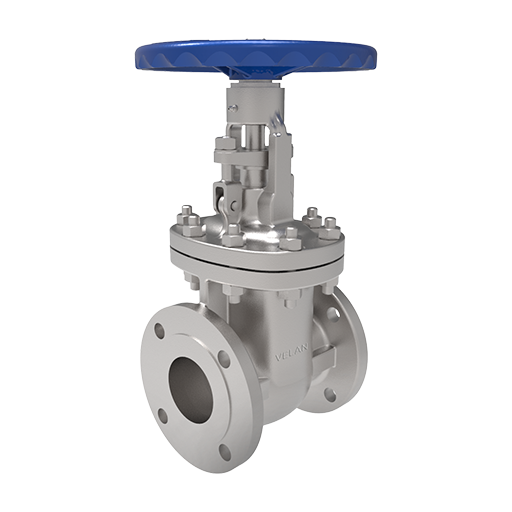
The most widely used gate valve design for Class 150 to Class 600 applications. The bonnet is bolted to the body with a raised-face spiral-wound gasket or ring joint. Outside Screw and Yoke (OS&Y) design means the stem threads are external — giving visible position indication (stem fully extended = valve open) and protecting the threads from the process fluid. Ideal for steam, oil, gas, and water service.
2. Pressure Seal Gate Valve
For high-pressure service Class 900, 1500, and 2500, a bolted bonnet becomes impractical — the number and size of bolts needed would be enormous. The pressure seal bonnet solves this elegantly: system pressure forces the seal ring against the body, so the higher the pressure, the better the seal. Used in power generation main steam lines, HP feedwater, and refinery high-pressure hydrocarbon service.
3. Non-Rising Stem (NRS) Gate Valve
In applications where vertical space is limited — underground pipelines, valve pits, below-deck marine installations — the non-rising stem (inside screw) design keeps the stem height constant during operation. The stem rotates to raise and lower the wedge, but doesn’t travel upward. Widely used in waterworks, fire protection, and buried gas distribution systems.
4. Knife Edge Gate Valve (Knife Gate Valve)
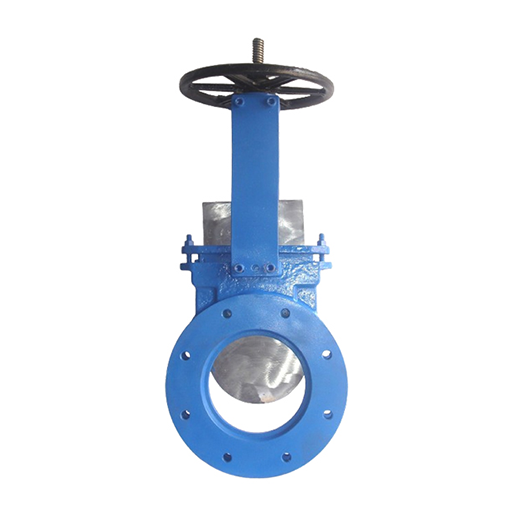
Designed for slurries, pulp, paper stock, wastewater, and any service containing solids that would jam a conventional wedge. The thin, sharp-edged gate cuts through fibrous media and seats cleanly, while the body is designed with a full-bore opening and no bottom cavity where solids can accumulate. Available in wafer, lug, and flanged bodies.
5. Sluice Gate Valve (Sluice Valve)
The sluice valve is the traditional gate valve for water distribution networks, treatment plants, irrigation systems, and firefighting mains. It features a solid rubber- or metal-seated gate and a non-rising stem for underground installation. Ductile iron or cast iron body with epoxy coating for corrosion resistance. Commonly used in BS 5163 / ISO 7259 specification.
6. Forged Steel Gate Valve
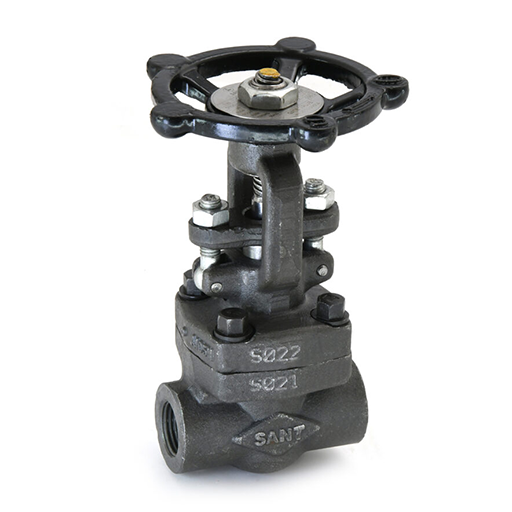
For smaller sizes (1/4″ to 2-1/2″) at high pressure, casting thin-walled bodies is not practical. Forged steel gate valves (per API 602 / ASME B16.34) offer superior strength-to-weight ratio, finer grain structure, and fewer defects than cast equivalents. Used in instrumentation isolation, high-pressure steam, and offshore applications.
7. Cryogenic Gate Valve
LNG, liquid nitrogen, liquid oxygen, and liquid argon services demand extended bonnet (cold box) gate valves that keep the packing and stem seal warm while the body is at -196°C. Cryogenic gate valves are made from low-temperature materials (ASTM A352 LCB/LCC, ASTM A351 CF8/CF8M) and tested per BS 6364 / ISO 21011 at cryogenic temperatures.
8. Cast Steel Gate Valve
The most common type for general process service. ASTM A216 WCB cast carbon steel bodies cover the widest range: Class 150 to 2500, 1/2″ to 36″. Alloy steel grades (WC6, WC9, C12) extend the temperature range for steam service. Stainless steel (CF8, CF8M, CF3M) and duplex grades handle corrosive process media. Available with bolted bonnet or pressure seal per class.
9. Pneumatic & Electric Actuated Gate Valve
Gate valves in remote locations, fail-safe systems, or ESD (Emergency Shutdown) loops are fitted with pneumatic (single/double acting) or electric motor actuators. The actuator mounts to the yoke via a standard ISO 5210 mounting flange. Spring-return (fail-open or fail-closed) pneumatic actuators are preferred in safety instrumented systems.
How a Gate Valve Works
A gate valve operates on a simple but highly effective principle: a flat or wedge-shaped disc (the “gate”) moves perpendicular to the flow stream. When the handwheel or actuator turns the stem, the stem threads engage the yoke nut, converting rotational motion into linear (up/down) movement of the wedge.
Open position: The gate retracts fully into the bonnet cavity above the flow path, leaving the bore completely unobstructed. This gives the gate valve its defining characteristic — essentially zero pressure drop and no turbulence when fully open, making it ideal for pipeline mainlines where pressure loss cannot be tolerated.
Closed position: The gate descends into two seat rings machined into the body bore. The wedge angle (typically 7°) creates a self-sealing mechanical interference between the gate and seats. In the most demanding applications, Stellite-hard-faced seats (Alloy 6, RC 38–42 hardness) resist erosion, galling, and thermal cycling over the valve’s service life.
Key operational rules for gate valves:
- Always operate fully open or fully closed — never partially open (throttling damages the seats and wedge)
- The backseat allows packing replacement under pressure when fully open
- For larger valves (typically above 8″), open the bypass before cracking the main valve to equalize pressure
Advantages of Gate Valves
- Full-bore, unobstructed flow — negligible pressure drop when open
- Bi-directional sealing — seals against flow from either direction
- Low turbulence — no flow disturbance in the open position
- Suitable for pigging — full-bore gate valves allow pipeline pigs to pass
- Wide material range — 24+ ASTM grades cover temperatures from -196°C to +650°C
- High-pressure capability — Class 2500 pressure seal designs to 6,170 PSI
- Low maintenance — infrequently operated; simple sealing mechanism
When NOT to Use a Gate Valve
- Throttling applications — partially open gate valves experience high velocity flow under the wedge, causing seat erosion and chattering; use a globe valve instead
- Frequent cycling — gate valves are designed for infrequent operation; high-cycle applications should use ball valves
- Slurry with large solids — solids can pack the bonnet cavity; use a knife gate valve instead
- Space-constrained vertical installations — the rising stem can be impractical; use a non-rising stem or ball valve
Gate Valve Applications by Industry
1. Oil & Gas — Upstream, Midstream & Downstream
Gate valves are the dominant isolation valve type across the oil and gas industry. Upstream wellhead tree valves, pipeline mainline block valves, manifold isolation, meter station block valves — all are typically gate valves. Pressure seal gate valves (Class 900 to 2500) serve high-pressure gas gathering, HP separation trains, and injection lines. Fire-safe designs with secondary Grafoil seats comply with API 607 / API 6FA requirements.
Key products: Forged gate valves, pressure seal gate valves
2. Petrochemical & Refinery
FCC unit catalyst lines, hydrocracker feed, amine treater regeneration, hydrogen high-pressure loop isolation — refinery gate valves must handle high-temperature, high-pressure, and often hydrogen sulfide-bearing fluids. Alloy steel grades (WC6, WC9, C5) handle the temperature range; NACE MR0175 hard-facing limits apply in H2S service.
Key products: Cast steel gate valves, stainless steel gate valves
3. Power Generation — Steam & Feedwater
High-pressure steam turbine inlet, main steam isolation, HP/LP bypass, boiler feed pump discharge, and feedwater heater isolation are core gate valve applications in power plants. Pressure seal bonnet designs with alloy steel (WC9, C12) or P91 bodies handle main steam conditions (Class 1500/2500, 540–600°C). IBR certification is mandatory for boiler-side valves in India.
Key products: Gate valves IBR
4. Water Supply & Water Treatment
Municipal water networks, water treatment plants, pumping stations, and fire suppression systems use gate valves (sluice valves) as the primary isolation and zone valve. Ductile iron bodies with epoxy lining (per AWWA C509/C515), non-rising stem, and flanged ends per ANSI/ASME B16.1 or BS 5163. Sizes 2″ to 48″.
Key products: Knife edge gate valves (wastewater), gate valves
5. Chemical & Acid Service
Corrosive fluid isolation in sulfuric acid plants, chlor-alkali units, fertilizer plants, and pharmaceutical synthesis requires stainless steel or exotic alloy gate valves. CF8M (316 cast) covers most chemical duties; CF3M (316L) for weldable versions; CN7M (Alloy 20) for sulfuric acid service; Hastelloy CW2M for HCl.
Key products: Stainless steel gate valves, duplex gate valves
6. Cryogenic Service — LNG, LPG & Industrial Gases
LNG receiving terminals, air separation units, and LPG storage use cryogenic gate valves with extended bonnets to protect the stem packing from cold temperatures. Low-temperature materials (LCB, LCC, CF8, CF8M) tested per BS 6364 at -196°C. Oxygen-cleaned versions for LOX service with fire-safe design per ASTM G88.
Key products: Cryogenic gate valves
7. Marine & Offshore
Hull valves, sea chest isolation, ballast system block valves, and pipeline risers on offshore platforms and FPSOs use gate valves specified to BS 6364 (offshore), NORSOK MDS standards, or API 6A. Duplex stainless steel (A995 Gr. 4A/5A) and super duplex provide chloride and seawater resistance in splash zones.
Key products: Duplex gate valves
8. Mining, Pulp & Paper
Mining slurry pipelines, thickener underflow, and pulp stock chests need knife gate valves that cut through fibrous and abrasive media. Cast iron or stainless steel knife gate valves with hardened seat liners handle abrasive tailings, paper pulp at 3–5% consistency, and mining reagent solutions.
Key products: Knife edge gate valves
Frequently Asked Questions — Gate Valves
A gate valve is a linear-motion isolation valve that opens and closes by raising or lowering a gate (wedge or parallel disc) perpendicular to the flow path. When fully open, the gate retracts entirely into the bonnet, leaving an unobstructed, full-bore passage with negligible pressure drop. When closed, the gate seats against two parallel seating surfaces in the body, achieving a tight shutoff. Gate valves are not suitable for throttling service because partial opening causes high-velocity flow to erode the gate and seat faces.
The terms are often used interchangeably in water-industry practice. Strictly, a sluice valve (also called a sluice gate valve) is a cast-iron or ductile-iron gate valve designed to BS EN 1171 / DIN 3352 for low-pressure water and wastewater service (up to PN 16 / Class 125). A steel gate valve per API 600 or ASME B16.34 covers the full pressure and temperature range from Class 150 through Class 2500 and is used in oil, gas, steam, and chemical service. Both operate on the same wedge-gate principle.
OS&Y stands for Outside Screw and Yoke. In an OS&Y gate valve, the stem threads are located outside the valve body, between the handwheel and the yoke. As the handwheel is turned, the stem rises visibly — a fully raised stem means fully open, and a flush stem means fully closed. This design provides immediate visual indication of valve position and is mandatory in fire-protection and many plant-safety applications where quick verification of open/closed status is required.
A standard gate valve uses a solid wedge-shaped gate seated against two angled seat rings and is designed for clean, non-slurry service (oil, gas, steam, clean water). A knife edge gate valve uses a sharp-edged, thin gate that cuts through fibrous, viscous, or slurry media and seats on a single flat face with a resilient liner. Knife gate valves are lighter, have shorter face-to-face dimensions (TAPPI or ASME B16.10 short pattern), and are standard in pulp & paper, mining slurry, wastewater, and food-processing lines.
Kalpataru manufactures nine gate valve types: (1) Bolted Bonnet OS&Y gate valve, (2) Pressure Seal gate valve (Class 900–2500), (3) Non-Rising Stem (NRS) gate valve, (4) Knife Edge gate valve, (5) Sluice gate valve, (6) Forged steel gate valve (Class 800/1500/2500), (7) Cryogenic gate valve (extended bonnet), (8) Cast steel gate valve (A216 WCB, A351 CF8M, etc.), and (9) Pneumatic / Electric Actuated gate valve. All types are available in sizes NPS 1/2″ to NPS 36″ across applicable pressure classes.
Request a Quote — Gate Valves
Kalpataru Piping Solution responds to all gate valve inquiries within one business day. To receive an accurate quotation with lead time, please share the following with your enquiry:
- Valve type (bolted bonnet OS&Y / pressure seal / forged / knife edge / sluice / cryogenic / actuated)
- Size (NPS / DN) and pressure class (Class 150 – 2500 / PN rating)
- Material of construction (body, trim, seat, packing — or service conditions so we can recommend)
- End connection (flanged RF / RTJ / BW / threaded) and facing standard (ASME B16.5 / EN 1092-1)
- Quantity and delivery location
- Special requirements: IBR, NACE, fire-safe (API 607), cryogenic, fugitive emission, TPI agency, PMI, radiography level
- Project name or purchase order reference (for expedited processing)
Have Any Questions ?
Please feel free to contact us. We will get back to you with 2 business days. Or just call us now.